

Source:
greatsynthesizers.com



Vibrato is a musical effect that involves the periodic, slight variation in pitch of a note, typically as a vibrating tone. Vibrato is used to add expression to performance and to create an emotional effect. In singing it can be done by varying one’s vocal pitch, while in instruments such as the guitar or violin it is achieved through small variations of pitch within the played note. Vibrato involves shaking or pulsing your finger to produce a slight, rapid variation in pitch. It’s a subtle but very noticeable effect that can be used as an expressive tool. If you want to learn how to use vibrato, there are quite a few things you’ll need to know before getting started
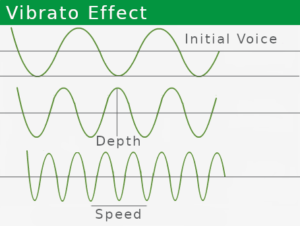
Vibrato is an essential part of good vocal technique. The word itself means “a slight wavering,” and it describes the movement of the larynx in singing. Vibrato has two components: amplitude (how big the movement is) and speed (how fast it happens). These are very important elements when determining if your vibrato is natural or forced.
There are three types of vibrato used in singing today. The first type, called Classical Vibrato, was developed by European teachers during the late 19th century. It’s characterized by a slow, smooth
Few types of vibrato-
Natural vibrato may be a present pitch variation created by an associate instrument or voice. In singing, natural sound comes from refined pulsation within the airway—including the vocal organ, tongue, and cartilaginous structure. In brass and wind instruments, the natural sound will come back from refined alterations inflow. On string instruments, natural sound may end up from the mild vibration of a string against the fingerboard.
It is called a vocal wobble when the vibrato changes pitch widely.
Caprino means “little goat” in Italian, and the fast technique evokes a kind of bleating goat sound. The sound should produce distracting vocal tones if it is not real.
The second type of vibrato is the right-hand vibrato. The guitarist uses his or her right hand to wobble back and forth over the fretboard, creating a wide swoop.
When vocalists or brass players use jaw vibrato to alter pitch, their lips, jaws, or tongues tremble. This technique is known as gospel jaw.
Tremolo
The first is the standard left-hand vibrato, where your hand moves up and down with a slight wavering motion. This is the most common type of vibrato, found in players like Bill Evans or Pat Metheny. It’s also called “tremolo” because of the typical effect you hear on radio stations using an old-fashioned horn.
Speed – The initial vibrato speed [ can be initial speed and final speed ]
Depth – The amount of pitch variance [ can be assigned at initial, mid, and final point]
There are many VST effect plugins are available for Vibrato, you can check our free VST plugin section for more details.




 Select Option